
How to read a smocking plate
A smocking plate is a chart of the stitching, drawn on a grid. Once you can read one, any plate in any collection is a set of simple instructions. This guide explains the grid, the lines and the way to work through a chart without losing your place.
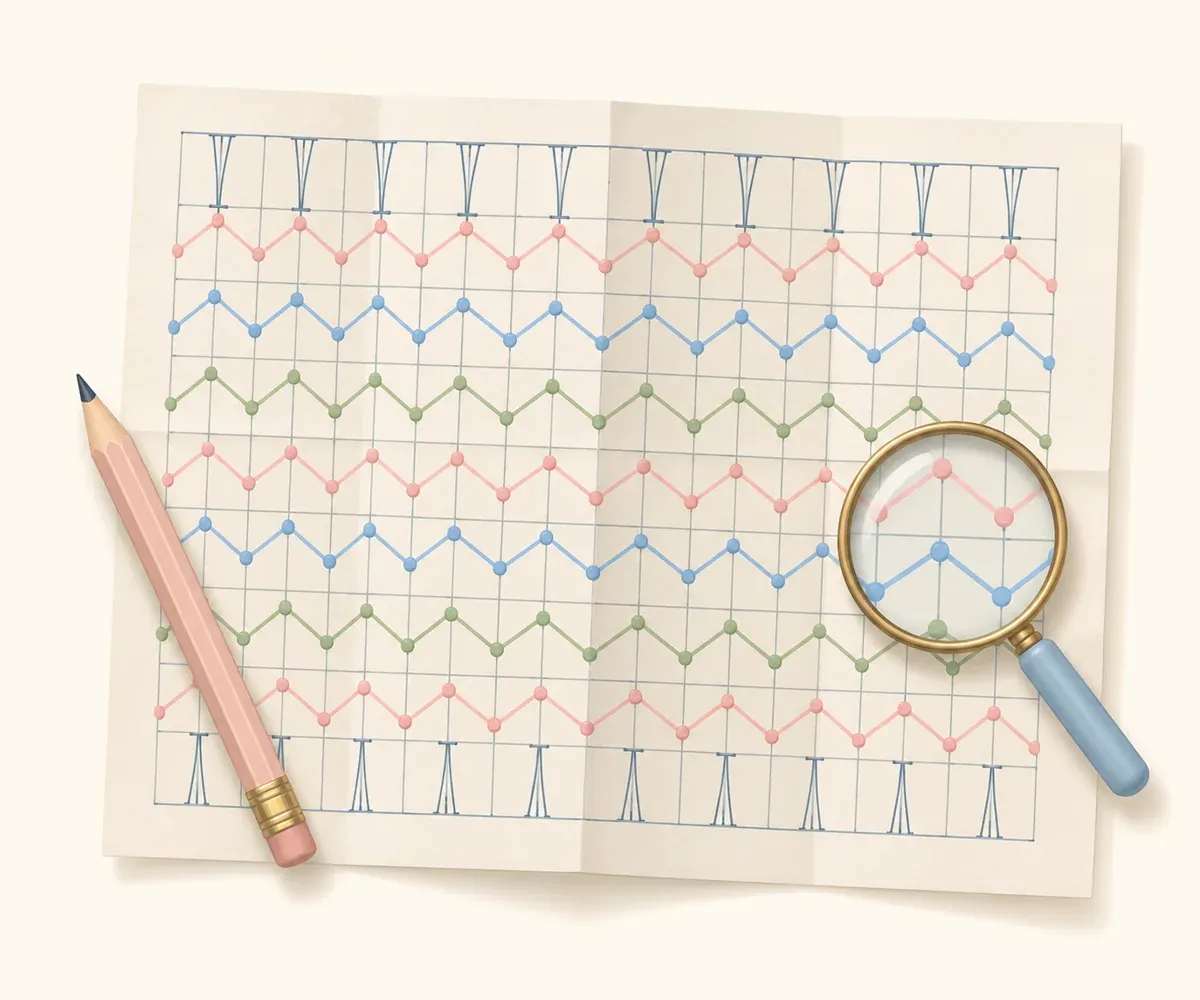
The grid
Vertical lines are pleats: the folds of fabric your pleater made. Dotted horizontal lines are the pleater rows, the lines of gathering thread you stitch along. In the plates on this site the pleats sit a quarter inch apart and the rows a quarter inch apart, so one grid square is one pleat wide and one row high.
What the colored lines mean
Each colored line is one pass of a stitch. The corners of the line are the bites: the points where the needle picks up a pleat. A line that stays level is a cable, outline or stem row. A line that climbs and falls is a wave or a trellis. Two crossing lines of the same color show a trellis or a surface honeycomb worked in two passes.
| On the chart | In the fabric |
|---|---|
| Level line | Cable, outline or stem row along one pleater line |
| Short zigzag | Baby wave: half row steps between two pleater lines |
| Long zigzag | Wave: climbs two rows in half row steps and comes back |
| Two crossing zigzags | Trellis: two passes in opposite phase that close into diamonds |
| Paired steps | Honeycomb: pairs of pleats joined on alternating rows |
Numbers around the chart
Pleat numbers run along the top and row numbers run down the left side. A small triangle above a pleat marks the center of a mirrored plate. On a wide plate only the center section is drawn and the pattern repeats outward on both sides.
Working a chart
- Start at row 1, the top row, and read left to right.
- Note the color and the stitch named at the start of the row in the written instructions.
- Find the first bite on the chart and pick up that pleat.
- Follow the line one bite at a time, keeping the thread on the side the stitch requires.
- At the end of the row, secure the thread at the back and move to the next row.
Checking the scale
Every printed PDF has a one inch square. Measure it before you rely on the printed chart. If it measures less than an inch, your printer scaled the page: print again at 100 percent.
To see a chart change as you adjust it, open the Plate Designer and try different stitches. For a ready made plate to read, start with Three Cable Rows.
A worked example: Wave Stripe
Open Wave Stripe and read its written instructions beside the chart. This is exactly what the engine writes for the two rows of that plate:
- Rows 1 to 3: Wave in Blush, pleats 1 to 29, 29 bites, 3 strands. Cable-style bites that climb two rows in half-row steps and come back down, one step per pleat.
- Row 4: Cable in Navy, pleats 1 to 29, 29 bites, 3 strands. Pick up each pleat on the row line and let the working thread fall alternately above and below the needle.
Notice how the two pieces of information match. The chart shows where the line goes, and the written row tells you the color, the pleats it covers, the number of bites and the movement to use. If the two ever seem to disagree, trust the written row and recount the pleats.
Mistakes that cost an evening
- Starting the first bite on the wrong pleat. Count in from the left edge and mark pleat 1 with a pin before you begin.
- Reading a wave as a trellis. A wave is one line; a trellis is two lines in opposite phase that close into diamonds.
- Skipping the holding rows. They are counted in the pleater setup line of every plate page, and they keep the pleats parallel.
- Trusting a printout that was scaled. Check the one inch square first.
Checking your own work
After each row, lay the plate beside the fabric and compare the shape. A level row should look level and a wave should rise and fall in the same rhythm across the panel. If the rhythm slips, unpick back to the last bite that matched the chart. It is much faster than finishing the panel and finding the slip at the end.
Read next
- Smocking guides: Seven smocking guides: reading a plate, using a pleater, sizing by chest, floss amounts, backsmocking, blocking and a glossary of stitches.
- Baby Bonnet and Bib Plates: Baby Bonnet and Bib Plates: eight printable smocking plates with sizing tables and floss estimates, $19 once, delivered as PDF and SVG.
- Boys' Jon-Jon Plates: Boys' Jon-Jon Plates: eight printable smocking plates with sizing tables and floss estimates, $19 once, delivered as PDF and SVG.